Credit Risk: Setting a Smarter Approval Cutoff
Finance
Can a lender cut default losses without rejecting too many good borrowers?
A lender wants to approve borrowers who will repay and decline borrowers who will seriously default, using only information available at application time. This project builds a simple, explainable risk score from a borrower’s credit history, using the Give Me Some Credit dataset of 150,000 borrowers, then answers where the approval cutoff should actually sit as a dollar question, not a statistics question.
Findings
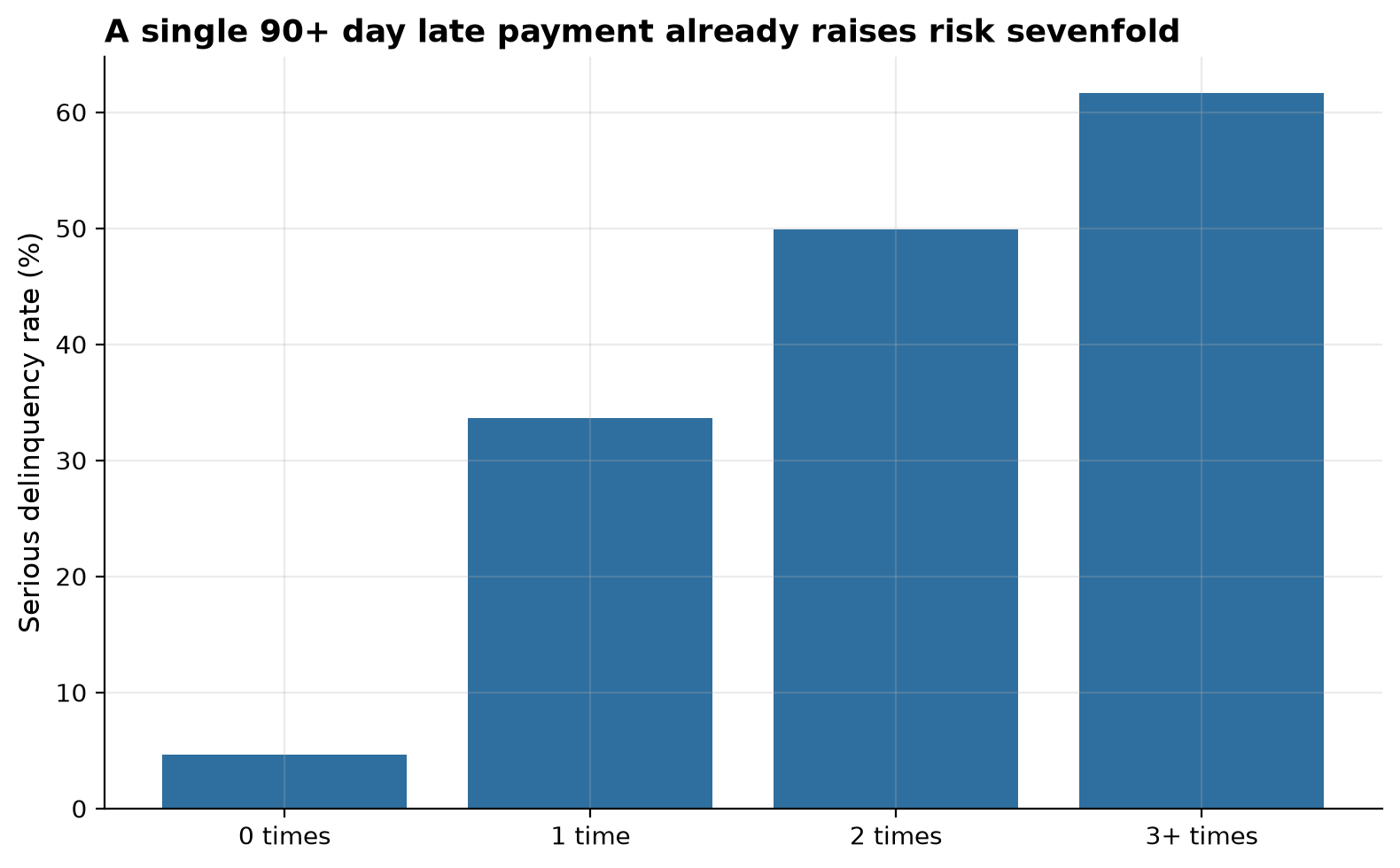
Late payment history is the strongest signal in the data. Borrowers with no 90+ day late payment default 4.63% of the time. A single such late payment already raises that to 33.66%, roughly seven times higher.
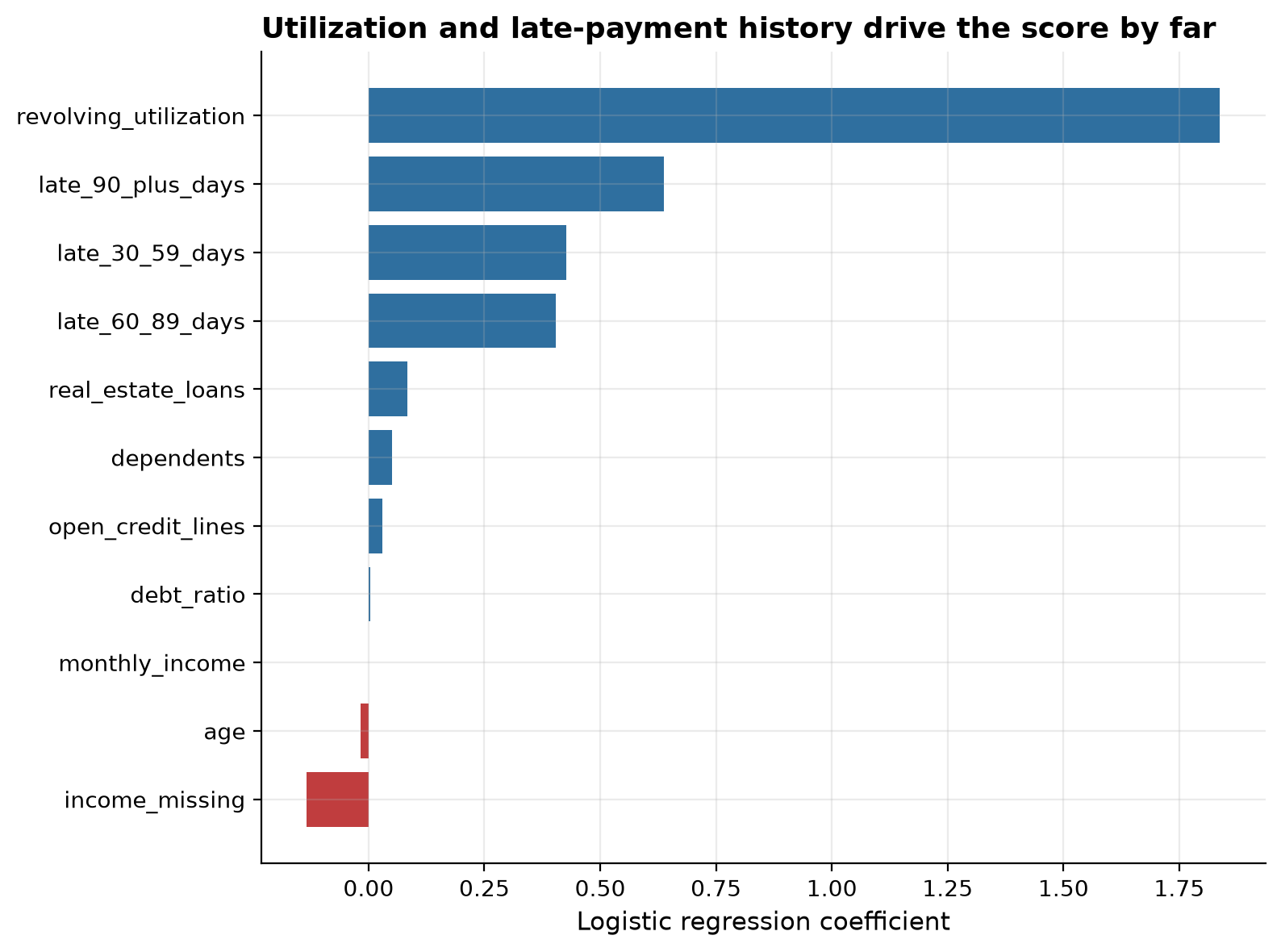
A logistic regression scores borrowers well while staying explainable. Trained on 11 features, the model reaches an AUC of 0.85 on held-out data, meaning it correctly ranks a random defaulter as riskier than a random non-defaulter 85% of the time.
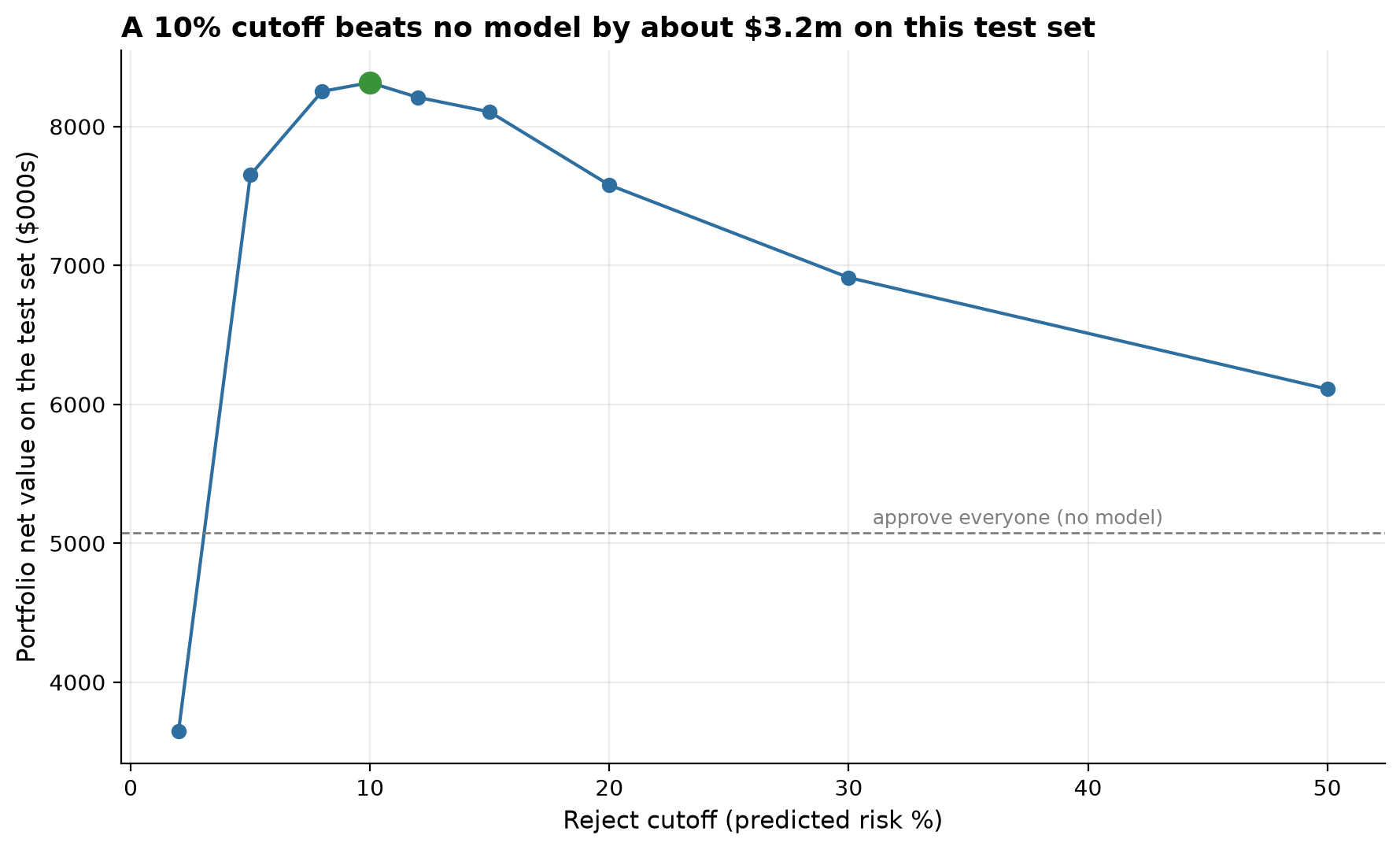
The right cutoff is a dollar question, not a statistics question. Under illustrative cost assumptions, rejecting anyone scored at 10% risk or higher catches 63.9% of defaults while only turning away 12.4% of good borrowers, lifting portfolio value by about $3.2 million on a 45,000-borrower test set. A more aggressive 2% cutoff catches nearly every default but destroys more value than it saves by rejecting 69.4% of good borrowers.
An accompanying Excel scenario model makes the two cost assumptions live, editable cells.
Live dashboard
A note on the data and tooling
This project was originally planned around Kaggle’s American Express Default Prediction dataset, which proved infeasible without Kaggle credentials (16-50GB, competition-gated). It was swapped for Give Me Some Credit, a smaller dataset with interpretable features, arguably better for a portfolio piece. It was also originally planned as a Power BI dashboard; built in Tableau instead after a Windows VM attempt to run Power BI proved impractical to drive. Full reasoning in the project README.
Full write-up
- Full report — methodology, limitations, and recommendations
- SQL and notebook on GitHub